Classroom activities - The Derivative
The following classroom activities contain a possible introduction to the concept of the derivative using the difference sequence. They can be used separately or as a complete classroom sequence.
 TT link
The aim of these activities is to impart the derivative's underlying concept as the
momentary rate of change in a certain point and its geometric meaning, as discussed in
didactic considerations.
Activity 1: Exploring difference sequences
This activity can be used to get started with working with the difference sequence as a predecessor of the derivative. It explores the relation between a sequence and its difference sequence and also the difference sequence's values and their graphical representation.
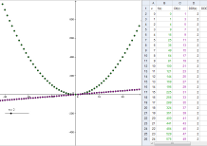
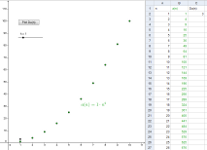
To a given sequence a(n) = k·n2 (green), we want to find its difference sequence Da(n) := a(n+1) - a(n).
a) Use the spreadsheet to create a cell formula which calculates the difference sequence's values in the cells C3 to C30.
b) Plot the first ten elements of the difference sequence with the button in the upper left part of the graphics window. Describe the shape of its graph. How is the graph's slope represented in the spreadsheet?
c) Now vary the sequence's equation with the slider. What happens with the difference sequence? How is its slope related to the value of the parameter k?
Activity 2: z-functions and difference functions
This activity introduces difference functions of difference functions, analogous to higher-order derivatives. It also lays the ground for the derivation rules of polynomials.
In the applet on the right, you can see the z-function f(z) = zn (green) with initially n = 2, and its difference function (purple) Df(z) = f(z+1) - f(z).
a) Describe the relation between the graphs and the tables of f and of Df.
b) Starting from Df(n), we build DDf(n). Describe the function DDf(n).
It is especially important to not only consider how DDf(n) is formed or what special shape it has in this case, but also its general meaning as analog of the second derivative: it describes how the rate if change is itself changing. Knowing this, it is easier to understand what happens in the case of polynomials of higher orders.
c) Describe the types of growth of f and Df. Can you give an equation for the function Df?
d) Now shift the slider to 3. What types of growth do f, Df and DDf have?
e) Experiment with the slider. Can you formulate a general conjecture about how the shape of the difference sequence depends on the shape of the sequence? What do you see in the spreadsheets with regard to DDf(n), DDDf(n) etc.? How can you explain this?
Activity 3: The Drop Tower
Task
A
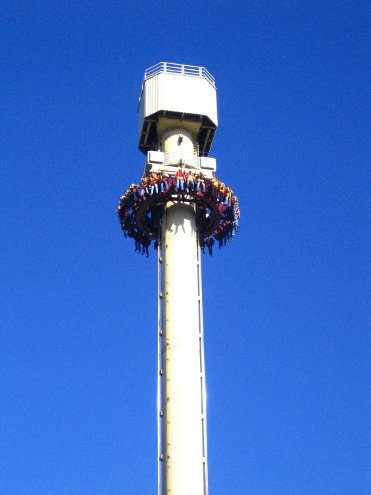
Drop tower is an amusement ride in which a gondola is lifted to the top of a large tower before being released and falling towards the ground.
The Drop tower's owner would like to advertise rides with their maximum speed. Without a speedometer, measuring the gondolas speed in a certain point is impossible - but we can calculate it.
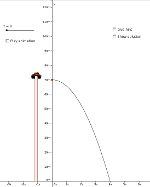
a) Calculate the gondola's average speed during the ride using the values in the applet's table on the right.
b) Have a look at the applet on the right and watch the animation. At what point does the gondola reach its maximum speed? There are several ways of observation. Give at least two!
c) Calculating the gondola's average speed during the entire ride is not precise enough. Calculate its average speed in each second of the ride. Again, use the applet's table to do so.
d) Why is the calculation in c) closer to the momentary speed of the gondola at a certain time than your previous calculation? Do your results support or contradict you conjecture from part b)?
When the students finished calculating the gondola's average speed in the given time intervals of length 1 second, a reduction of the intervals' length should follow.
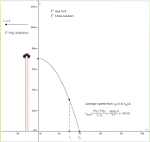
e) As you have calculated, the gondola reaches its maximum speed at the end of the ride. Having calculated the average speed of the last second, what do you think happens with the average speed if you reduce the time interval's length to 0.5 seconds or shorter? Will it be closer or farther apart from the momentary speed in t=4? Experiment with the second applet on the right and describe your observations.
From the observation that the average speed will approach the momentary speed if the length of the given time interval decreases, it is easy to lead to infinitely small time intervals using the mathematical concept of the limit:
v(t_1) \approx v_{avg}(t_1,t_2) = \frac{f(t_1) - f(t_2)}{t_1 - t_2},
for close t
1 and t
2 and therefore
v(t_1) = \lim_{t_1 \rightarrow t_2} v_{avg}(t_1,t_2) = \lim_{t_1 \rightarrow t_2} \frac{f(t_1) - f(t_2)}{t_1 - t_2},
which is the mathematical definition of the derivative.
 Download here