 TT link
Didactical Discussion - The introduction of the Derivative
This section describes a way to introduce the basic concept of the derivative using the difference sequence and compares it with the introduction which uses the tangent line to a graph. A corresponding classroom activity is available. TT link
TT link
A starting point of the introduction of the derivative in mathematics classes is discussing the rate of change in environmental situations, e.g.
- The path s_2 - s_1 of a car in a specific time span t_2 - t_1 and considering the average velocity \frac{s_2 - s_1}{t_2-t_1}.
- The change of the volume V_2 - V_1 of water which is poured into a vessel at a constant speed during a time span \Delta t. The relative rate of change is \frac{V_2 - V_1}{\Delta t}
- ...
From a geometrical point of view, the rate of change of a given graph of a function is related to the problem of the slope of a secant to a given graph.
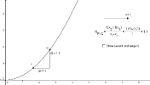
Interactive applet: The rate of change and the problem of the tangent to a given graph
 Download here
The usual way towards the concept of derivative is to choose two points P = \left(x_1;f(x_1)\right) and Q = \left(x_2;f(x_2)\right) on a given graph and to consider the secant through these two points. When Q approaches - dynamically seen - P, the question arises how the slope of the secant or the difference quotient of P und Q
m_{P,Q} = \frac{f(x_2) - f(x_1)}{x_2 -x_1}
will behave. The numerical representation of this process shows that the slope of the secant approaches a specific value.
Example:
Let f(x) := x^2, P\left(1;1^2\right) and Q\left(1+h; (1+h)^2\right), so here it is x_2 = x_1 + h; h \geq 0. Then we get:
Let f(x) := x^2, P\left(1;1^2\right) and Q\left(1+h; (1+h)^2\right), so here it is x_2 = x_1 + h; h \geq 0. Then we get:
m_{P,Q} = \frac{(1+h)^2 - 1^2}{1+h-1} |
|
The calculation of the limit of the rate of change if Q approaches P can be calculated – for polynomial functions - on the symbolic level, e.g. for f(x) = x^2:
m_{P,Q} = \frac{f(x_2) - f(x_1)}{x_2 - x_1} = \frac{x_2^2 - x_1^2}{x_2-x_1} = \frac{(x_2 - x_1)(x_2+x_1)}{x_2-x_1} = x_2+x_1
The limit of this difference quotient for x_2 \rightarrow x_1- the differential quotient in the point P - defines the slope of the tangent in the point P. This slope is called the derivative of f in the point P.
This methodical way emphasizes the relation between the algebraic and the geometrical representation.
This methodical way emphasizes the relation between the algebraic and the geometrical representation.
Remark concerning the tangent line of a graph
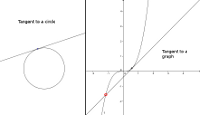
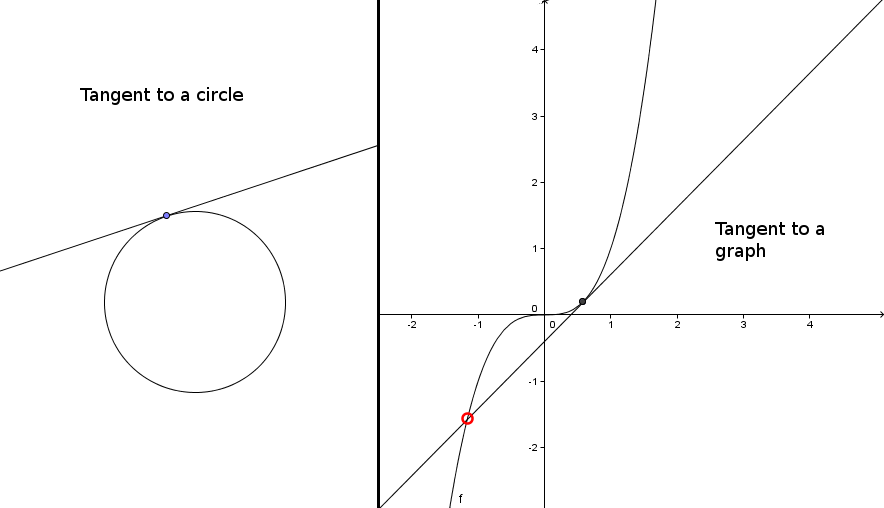
While the tangent to a circle is defined as the straight line that touches the circle in only one point, the tangent to a graph touches it in a certain point, but might also intersect with the graph in another (see graphic on the left, click to enlarge). It might even intersect in the very point where it "touches" the graph, as it does with the graph of f(x) = x^3 in x = 0. The tangent's global property of touching the circle in only one point is replaced by the local property, where the tangent optimally approximates the graph in the respective point.
Summary
The problem with the access to the derivative using the slope \frac{\Delta f}{\Delta x} is the limit process of a quotient with a nominator and denominator approaching zero. It is especially for students surprising the quotient itself might approach a specific value. The following access tries to construct basic perceptions of the rate of change on a discrete way of thinking and working.
The problem with the access to the derivative using the slope \frac{\Delta f}{\Delta x} is the limit process of a quotient with a nominator and denominator approaching zero. It is especially for students surprising the quotient itself might approach a specific value. The following access tries to construct basic perceptions of the rate of change on a discrete way of thinking and working.
Introduction using the difference sequence
The introduction of the derivative using the difference sequence of course also needs the limit concept for the definition of the derivative, but it starts with a discrete view of the problem. The classroom activity section contains examples for this approach.
The striking advantage, especially compared to the previously discussed introduction, is the chance for reaching a deeper understanding of the limit process and the relation between the function (the sequence) and its derivative (difference sequence): The difference quotient develops from the discrete difference sequence with step distance 1 to the differential quotient with infinitely small distance between the considered points.
This approach can be seen in four steps:
- Sequences and their difference sequences using positive integers
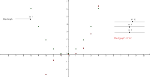
Let a(n) be a sequence a: \mathbb{N} \rightarrow \mathbb{R}, n \in \mathbb N. Then D_a(n) := a(n+1) - a(n), n \in \mathbb N denotes the difference sequence of a. The difference sequence denotes the absolute change of the sequence in one step. The behaviour of the graph of the difference sequence shows the applet on the right.
- Expand to the integers
 and calculate relative differences in intervals with integer lengths
The expansion results in mappings f : \mathbb Z \rightarrow \mathbb R called z-functions and their difference functions, which are analogously defined to the difference sequence. The difference quotient may be introduced as follows:f_{avg}(z_0,z_1) = \frac{f(z_1)-f(z_0)}{z_1 - z_0}, \text{ with } z_0, z_1 \in \mathbb{Z}Instead of the absolute change, the difference quotient now denotes the function's relative change. For z_1 = z_0 +1, the relative change is equal to the absolute change.
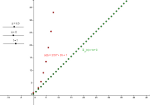
- Expand to special rational numbers Q _n = \left\{ \frac p n | p \in \mathbb Z \right\}, n \in \mathbb{N} by calculating relative differences in smaller intervals of rational length
This expansion works exactly as in the previous step, although calculating the relative differences becomes more complex using the difference quotient. The use of dynamic applets as the one on the right helps to make the connection to the previous step more natural by dynamically displaying the decreasing distance between q_0 and q_1. With the distance decreasing, the difference quotient approaches the derivative.f_{avg}(q_0,q_1) = \frac{f(q_1)-f(q_0)}{q_1 - q_0}, \text{ with } q_0, q_1 \in Q_n - Expand to the real numbers
 by using the limit concept, leading towards the introduction of the derivative
Using dynamic media like the applet of the previous step might reduce the difficulties by giving a basis for argumentations by providing analogies on a discrete level. The derivative can then be defined starting from the difference quotient of the previous step and extending it to the real numbers.x_0, x \in \mathbb{D}_f \subseteq \mathbb{R}: f'(x) = \lim_{x \rightarrow x_0} \frac{f(x) - f(x_0)}{x - x_0}
Summary
This way is an example of the interrelated use of multiple representations. They connect the various aspects of the derivative and relate the graphical, numerical and dynamical points ov view to each other.
This way is an example of the interrelated use of multiple representations. They connect the various aspects of the derivative and relate the graphical, numerical and dynamical points ov view to each other.